
Farming Smarter continues to build on the incredible momentum of last year as field work begins for a record number of plots in 2026.
Research teams have a total of 186 trials underway in 2026, amounting to 10,854 plots, setting a new record for the Lethbridge-based non-profit.
This record growth comes off the back of an incredibly successful 2025 season, which saw Farming Smarter teams complete 172 trials with 7,726 plots. To support the 40% increase in plots, Farming Smarter secured new equipment, new field locations along Highway 3, and new staff.
“This is a record year for us, and we are very excited for that. It means that companies understand the value and importance of the work that we do,” says Trevor Deering, Commercial Innovation Manager at Farming Smarter.
Deering’s team works alongside agri-businesses to help them achieve their commercialization goals by delivering unbiased, third-party research. They will work with 20 companies this year, four of which represent new and exciting partnerships.
Deering looks forward to strengthening the existing relationships with his 16 returning clients. In particular, his latest projects with Bayer Crop Science this year have him eager to get into the field.
“We’re working with three Bayer divisions to conduct a variety of selection trials for corn, canola seed and camelina,” says Deering. “Corn for feed & silage and canola seed production are powerful industries in Southern Alberta. Camelina is a novel crop and a great option for producers to consider.”
Additionally, this is the third year of Deering’s trial work with GS Dunn to provide farmers in southern Alberta with valuable insights into mustard agronomy.
This project has seen exciting results and will be featured with the audience of the Farming Smarter Field School on June 25 as part of a two-session program focused on alternative oilseed options for mustard and flax production!
Potato agronomy research continues to be a major focus for Lewis Baarda and his team.
“This year’s potato program includes more than a dozen trials that will support our potato industry by generating reliable local information,” says Baarda, Field Tested Manager at Farming Smarter.
Through Baarda, Farming Smarter is dedicated to advancing the regional knowledge of potato agronomy available to producers with both grant-funded trials and industry partnerships. Part of the partnership with McCains Foods will research viable potato varieties for the region as well as fertility optimization trials.
Among the equipment Farming Smarter acquired to support its growth in 2026 is a new potato planter that allows the seeding of different varieties in each plot or even row. Additional potato equipment includes two climate-controlled potato storage units, a new potato topper for vine management, and an upgraded audit system that enhances the accuracy of data quality.
Farming Smarter’s Research Scientist, Dr. Thierry Fonville, is most excited for the two new projects the Agronomy Research program is starting this year – reduced irrigation allocation management for spring wheat and sustainable pulse crop production.
While the latter aims to arm producers with better management practices to encourage adoption of pulses, the former looks to help producers plan for drought.
“We are trying to get a better idea of how to maximize the potential of pulses,” Fonville says about the new pulse crop project. “This project will help develop sustainable practices that can lead to reduced fertilizer use, in combination with the implementation of strip tillage to reduce soil erosion.”
The reduced irrigation allocation project will use sprinkler systems to manage water allocations at each plot. This allows the team to limit irrigation water and collect data on crop performance under various levels of water restrictions, like those seen placed on farmers and municipalities in previous years of extremely dry weather that saw reservoirs drop to critical levels.
“Growing crops under water restrictions creates a substantial risk for producers. We want to help them prepare for these conditions in the future,” says Fonville.
The team hopes to use the data collected from studying the impact of reduced irrigation allocations on spring wheat to build a future project that includes more crops commonly grown in southern Alberta.
Farming Smarter is proud to help the industry forge a successful path into the future. Currently, Farming Smarter is Alberta’s largest agriculture innovation hub, conducting more agronomy research trials and all of the province’s post-secondary institutions combined.
Agriculture accounts for almost 20% of GDP in the Lethbridge region, per Economic Development Lethbridge, and Farming Smarter is eager to see that impact grow!
Learn more about Farming Smarter's current and past research projects here.
|
|
Building and Inspiring a Culture of Innovation in Western Canada AgricultureFarming Smarter is an agriculture innovation hub based out of Lethbridge, Alberta. Our mission is to support the people involved in advancing irrigated and dryland crop production. We work closely with farmers, entrepreneurs, businesses, government, academia and more to bridge the innovation gap, drive economic growth, improve social impact and environmental sustainability. We are a policy governed, non-profit organization with by-laws under the Alberta Societies Act, and a Canadian Charity registered under the Canada Revenue Agency. If you like what we do, please consider supporting Farming Smarter by making a donation, sponsoring us, or come to us for your agricultural research needs. Innovation is hard and about long-term results. We invite anyone interested in agriculture innovation to work with us and together we can change the way people farm. |
Other Articles
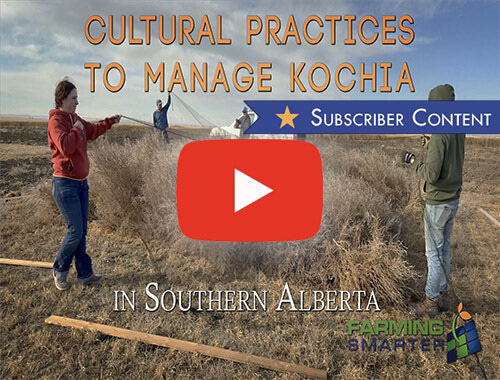
Kochia management is incredibly important for southern Alberta growers and Farming Smarter is taking charge to bring them cutting edge practices. Catch up on videos of our project work from this year and see what we plan to do next year!
The Fall 2025 Farming Smarter magazine is packed with fantastic stories and cutting edge agronomy knowledge from southern Alberta's agriculture industry. Keep your eye out for a hard copy in the Western Producer, Oct. 30!
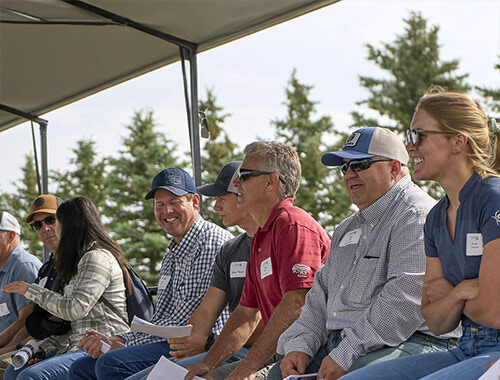
This winter, you and your team to have every opportunity to develop the best skills, cultivate the best network, and learn what's cutting edge in the field. Agronomy Smarts is the simplest way to unlock a wealth of information and fantastic network in agriculture!